Shared Awareness at Mission ScaleShared Awareness at Mission Scale
Real World Mission: Frontline CommandReal World Mission: Frontline Command
In contested operations, information is everywhere: across sensors, teams, and operational areas. The advantage comes from getting the right information to the right decision-makers at the right time.In contested operations, information is everywhere: across sensors, teams, and operational areas. The advantage comes from getting the right information to the right decision-makers at the right time.
The ProblemThe Problem
Every unit running sensors is generating detections. None of them automatically reach the units that need them. In today's paradigm, getting information from one node to another still depends on manual communication. This takes time, creates a detectable electronic signature, and relies on connectivity which, in contested environments, cannot be assumed.Every unit running sensors is generating detections. None of them automatically reach the units that need them. In today's paradigm, getting information from one node to another still depends on manual communication. This takes time, creates a detectable electronic signature, and relies on connectivity which, in contested environments, cannot be assumed.
Shared awareness breaks downShared awareness breaks down
A detection made in one area of operation rarely reaches the adjacent units that need it. What one team sees, another team doesn't know.A detection made in one area of operation rarely reaches the adjacent units that need it. What one team sees, another team doesn't know.
Manual coordination creates bottlenecksManual coordination creates bottlenecks
Relaying detections up and down the chain requires operators to stop, call, confirm, and relay. At the pace of modern operations, that delay becomes a liability.Relaying detections up and down the chain requires operators to stop, call, confirm, and relay. At the pace of modern operations, that delay becomes a liability.
Radio calls expose positionRadio calls expose position
Every transmission carries an operational and electronic signature. In environments where the adversary is listening, the act of coordinating is itself a risk.Every transmission carries an operational and electronic signature. In environments where the adversary is listening, the act of coordinating is itself a risk.
Connectivity loss means operational blindnessConnectivity loss means operational blindness
Systems that depend on centralized networks or cloud infrastructure degrade to near-zero capability the moment connectivity is lost. Teams lose access to critical information precisely when awareness matters most.Systems that depend on centralized networks or cloud infrastructure degrade to near-zero capability the moment connectivity is lost. Teams lose access to critical information precisely when awareness matters most.
The ExecutionThe Execution
The OutcomeThe Outcome
Why It MattersWhy It Matters
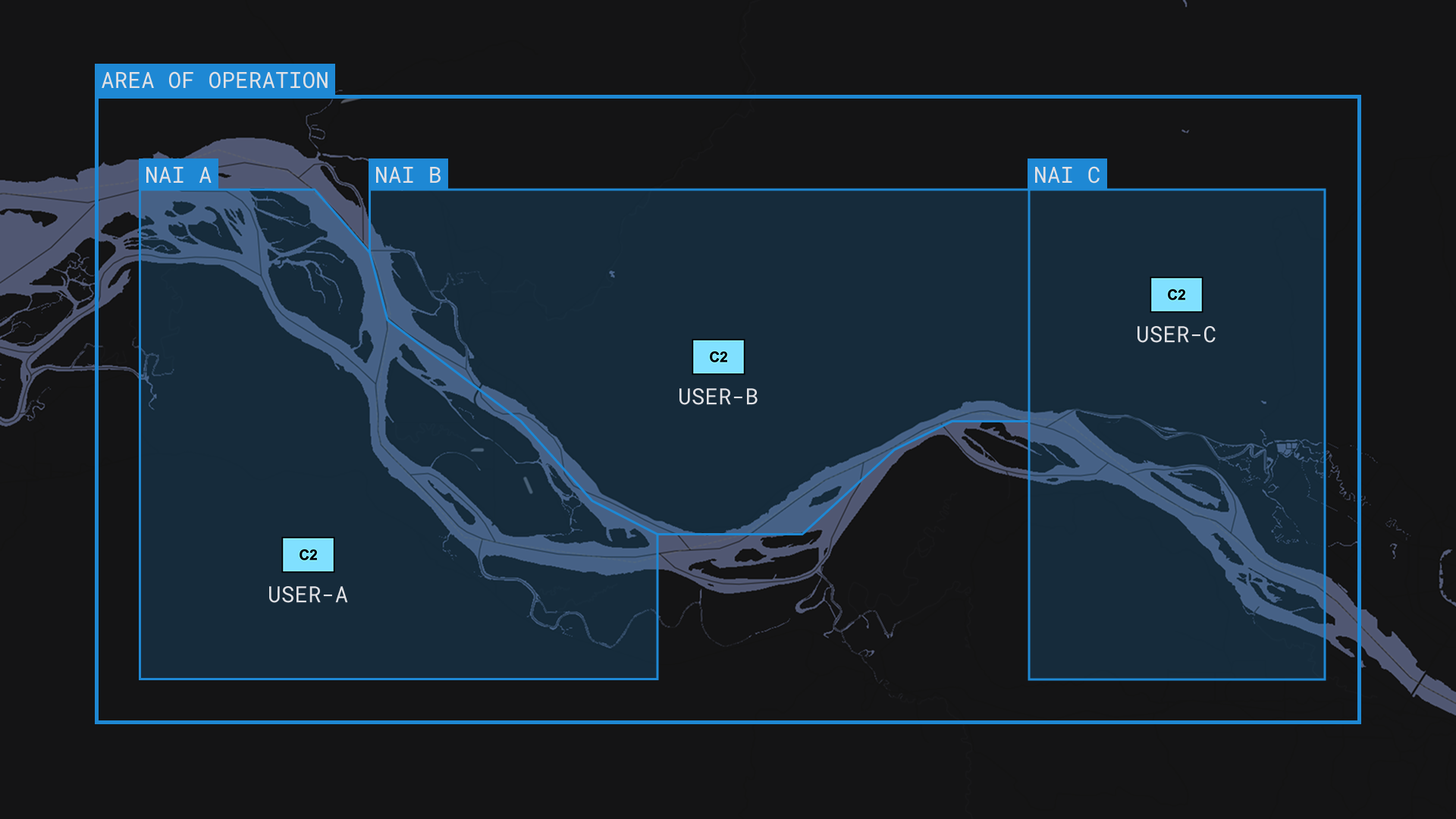
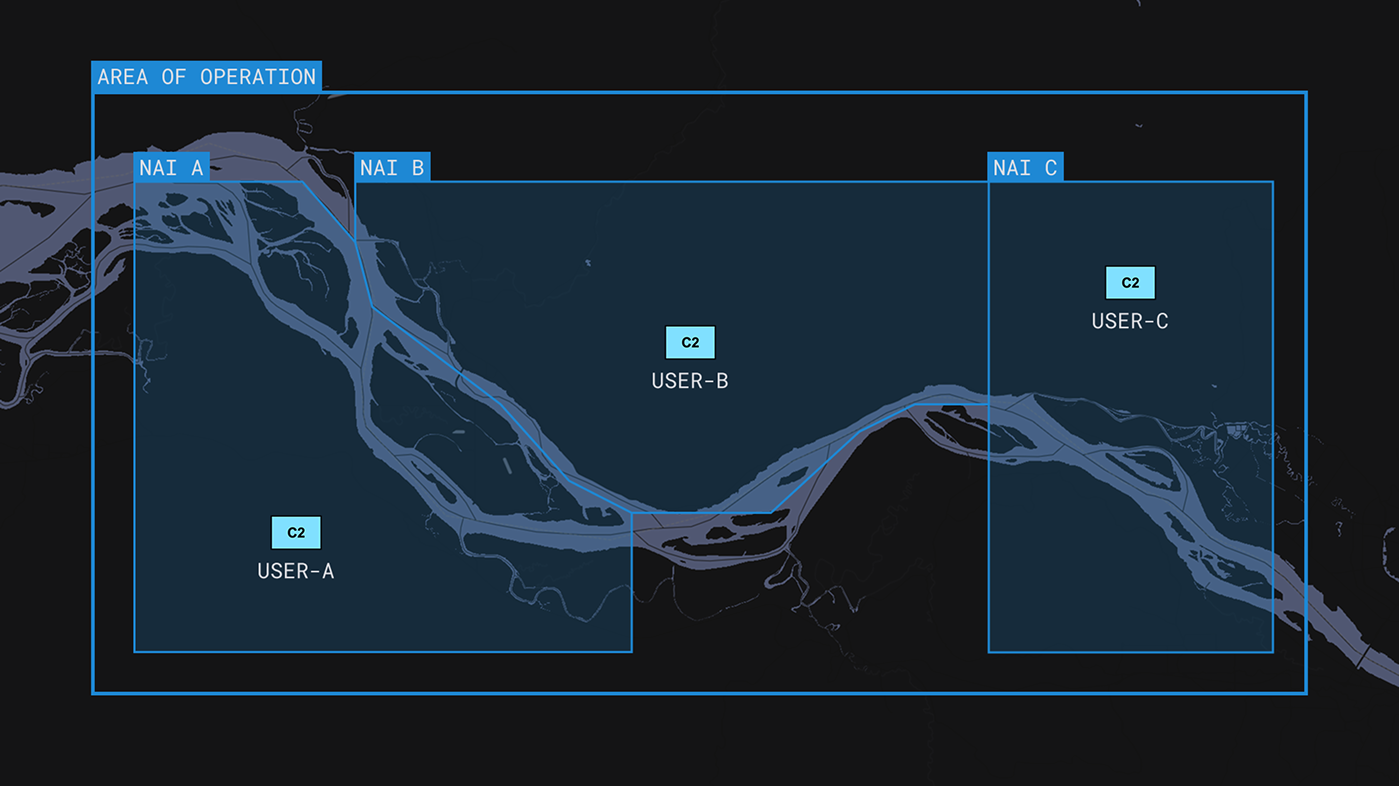
Consider a distributed operation spanning multiple areas of responsibility. A commander has an area of operation containing three Areas of Operations— each running Frontline Perception on their own sensors, each building their own picture of their local environment. The challenge is that those operational pictures remain isolated.
Unit A detects a threat moving toward Unit B's area. In the traditional approach, that detection triggers a radio call or a time-delayed link entry. The call goes up the chain. The commander relays it down to Unit B. Time passes. Operators become part of the information pipeline. Additional communications increase signature risk. By the time Unit B has the information, the situation has already changed.
Frontline Command automatically discovers, prioritizes, and disseminates the detection. The moment Unit A's sensors identify the contact, it flows directly to Unit B and to the commander — without a radio call, without manual relay, without delay, in what link or format needed. Unit B's operator sees the threat in their operational picture before it crosses into their area. The commander has a single operational picture across all three areas of operation simultaneously.
Each unit subscribes automatically to what's happening in adjacent areas. Operators don't see everything — they see what's relevant. What's near them, what's moving toward them, what the units on either side are tracking. If something further away becomes strategically significant, operators can subscribe to it. Shared awareness scales with the mission without requiring additional manpower or increasing cognitive load.
And when connectivity breaks — and in contested environments, it will — awareness doesn't disappear. Adjacent teams continue sharing awareness through resilient mesh networking. Detections still flow. Models still update. The commander may lose visibility of the full operational picture, but every unit retains its local picture and its connections to the units nearest to them.
- Relevant detections automatically reach the right operators and command nodes — no manual relay required
- Shared awareness is maintained across units and operational hierarchies without manual coordination
- Commanders have a single operational picture across all areas of operation simultaneously across heterogeneous assets
- DDIL resilience — each node continues operating and sharing through mesh when centralized connectivity is lost
- Every unit sees what's relevant to them and their mission, subscribes to what matters beyond their area of operation
- Human-on-the-loop throughout — operators control what they act on, Command controls what reaches them
Shared awareness is the foundation of mission-ready decisions at the edge. Without it, teams are forced to make decisions with incomplete information — making calls based on what they can see, unaware of what the unit next to them may already know.
Frontline Command delivers the right information to the right decision-makers at the right time, enabling faster, better-informed decisions without increasing cognitive load. The right information reaches the right operator automatically — not because someone relayed it, not because someone asked for it, but because Frontline Command automatically discovers, prioritizes, and disseminates information across the operational picture.
That capability holds in DDIL environments where other systems fail. Because Frontline Command is edge-first by design, losing connectivity doesn't mean losing awareness.
Shared awareness. Better decisions. Faster action. Frontline Command.