One Fleet, Coordinated ActionOne Fleet, Coordinated Action
Real World Mission: Frontline AutonomyReal World Mission: Frontline Autonomy
The U.S. military has fielded autonomous or uncrewed platforms across every domain — surface and undersea vessels, aerial systems, ground robots. Operating them together in contested, disconnected environments – with a fraction of the manpower currently required – remains one of the most pressing unsolved challenges in modern operations.The U.S. military has fielded autonomous or uncrewed platforms across every domain — surface and undersea vessels, aerial systems, ground robots. Operating them together in contested, disconnected environments – with a fraction of the manpower currently required – remains one of the most pressing unsolved challenges in modern operations.
The ProblemThe Problem
Each platform in a modern autonomous fleet operates with its own isolated picture of the world. Coordinating them requires multiple operators per platform and a human directing every action.Each platform in a modern autonomous fleet operates with its own isolated picture of the world. Coordinating them requires multiple operators per platform and a human directing every action.
No shared pictureNo shared picture
A detection on one vessel does not propagate across the fleet, preventing systems from acting on a shared understanding of the environment.A detection on one vessel does not propagate across the fleet, preventing systems from acting on a shared understanding of the environment.
No interoperabilityNo interoperability
Platforms from different manufacturers operate independently, preventing coordinated execution, autonomous task handoffs, and fleet-level behavior across systems.Platforms from different manufacturers operate independently, preventing coordinated execution, autonomous task handoffs, and fleet-level behavior across systems.
Operator burden at scaleOperator burden at scale
As the number of platforms increases, the manpower required to monitor and analyze them grows just as quickly. What starts as a manageable operation can rapidly expand into large teams working around the clock just to maintain coverage. The traditional model does not scale efficiently as sensor volume and operational tempo increase.As the number of platforms increases, the manpower required to monitor and analyze them grows just as quickly. What starts as a manageable operation can rapidly expand into large teams working around the clock just to maintain coverage. The traditional model does not scale efficiently as sensor volume and operational tempo increase.
Lost custodyLost custody
Without coordinated custody across systems, operators must manually retask assets to reacquire and reconfirm contacts. Every reconfirmation costs time and creates risk.Without coordinated custody across systems, operators must manually retask assets to reacquire and reconfirm contacts. Every reconfirmation costs time and creates risk.
The ExecutionThe Execution
The OutcomeThe Outcome
Why It MattersWhy It Matters
Autonomous platforms generate more sensor data than any operator can process — across radar, electro-optical, infrared, and radio frequency feeds running simultaneously on every platform in a fleet. The question is whether that data can be correlated across platforms in real time, turned into a shared picture, and used to direct coordinated action — without an operator managing every step.
The Joint Staff put that question directly to TurbineOne and an Unmanned Surface Vehicle provider. The scenario: a swarm of unmanned surface vessels autonomously detecting, tracking, maintaining custody of, and intercepting a contact with a human on the loop.
TurbineOne inserted one constraint from the start: no satellite connectivity required. Everything would run over point-to-point radios. The USV provider’s own system-required satellite. This exercise wouldn't.
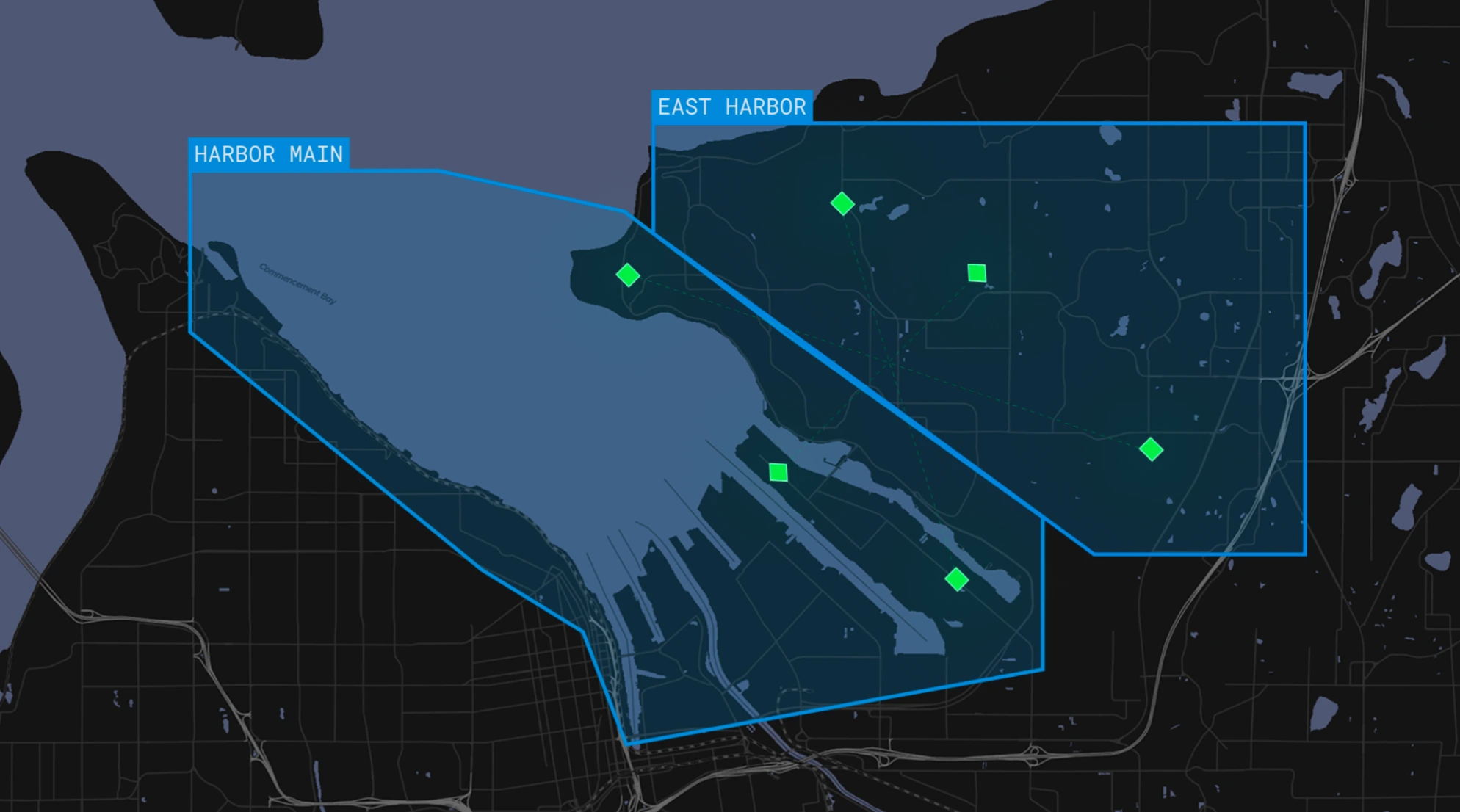
In a Joint Staff demonstration, TurbineOne built a detection model on-site from 20 minutes of footage of the target vessel. Three platforms deployed in congested waterspace, each running Frontline Perception, each building its own picture of the world from its own sensors. Those pictures were correlated in real time, even possible in a denied and disrupted environment.
Every platform confirmed it was tracking the same contact. The target vessel moved through the harbor. The first platform to detect the contact initiated an autonomous fleet-wide handoff, allowing other systems to maintain custody without direct operator tasking.
Three platforms. Three sensor sets. One operator.
The same architecture then needed to prove it could enable intelligence sharing and coordinated awareness across platforms that were never designed to work together — from different manufacturers, running different software stacks. Recent experiments with the Office of Naval Research and other government-sponsored evaluations operationalized exactly that. Platforms from multiple manufacturers now running the same payload in contested environments — listening passively for threat radio frequency signatures, automatically tip-and-cueing the camera system to the location of the contact, returning a small data packet with lat/long rather than full motion video.
Minimal signature. Maximum information.
Frontline Autonomy doesn't replace the autonomy stacks inside these platforms. It sits above them, connects them through open APIs, and coordinates a fleet from multiple manufacturers as a single operational system under an operator’s intent.
That is the larger shift underway: moving from isolated platforms to a unified sensing and decision-making network. A fleet no longer operates as a collection of individual systems, but as a coordinated layer of distributed intelligence — autonomously sharing custody, prioritizing threats, and executing coordinated actions across distributed systems. As more platforms, sensors, and payloads come online, the advantage will not come from any single piece of hardware. It will come from the ability to connect them all into a common operational fabric that scales across missions, services, and theaters without increasing operator burden.
- Three platforms, three sensor sets → one operator
- Autonomous detection, contact correlation, and intercept — no internet required
- Human on the loop throughout — custody maintained from detection to intercept
- Expanded to platforms across multiple manufacturers under government-sponsored cooperative research and development effort
- Now forward-deployed to contested environments
- Links to press coverage
In contested environments, presence alone can create risk to our forces and missions. Autonomous systems change that equation by extending awareness, persistence, and coordination into places where continuous human operation is difficult, costly, or dangerous.
Once a contact of interest is identified, custody can be maintained continuously across a distributed network of platforms and sensors — preserving the operational picture even as individual assets cycle, reposition, or hand off responsibility. Persistent awareness compresses the gap between detection and decision, allowing smaller teams to operate with a level of speed and coordination that traditionally required far larger forces.
Frontline Autonomy is designed to sit above existing autonomy stacks, allowing different systems to operate together without replacing the software already running on them. Instead of treating each platform as an isolated asset, the architecture enables autonomous systems to autonomously share tasks, hand off custody, and execute coordinated behavior across a distributed fleet. Aerial, maritime, terrestrial, and fixed systems can all contribute based on their strengths, with autonomy handling the execution and synchronization required to maintain persistence, custody, coverage, and operational tempo. The result is not just a shared operating picture, but a force that can act with greater endurance, adaptability, and scale while requiring fewer operators to manage it.
That is the broader shift this modular open systems approach enables: from isolated systems operating independently to distributed autonomous networks executing together as a coordinated fleet under operator intent.